Contact us on WhatsApp: +86 13913801295 Email: kongsi@megodoor.com


In food factories, beverage plants, cooked food workshops, central kitchens, seasoning production facilities, and similar environments, hygiene management standards are usually much higher. Especially in summer or in warm regions, mosquitoes, flies, moths, and other insects are more likely to gather around factory entrances. If the factory door system is not properly designed, or if the opening method is not well planned, insects can easily enter the workshop.
For food-grade factories, a door is not just an access point. It is also an important part of workshop hygiene control. To reduce insect entry, it is not enough to rely on only one device. A more practical approach is to consider the door system, door opening logic, air isolation, and insect-control accessories together. In real projects, high-speed roll-up doors, double-door interlocking, air curtains, yellow strip curtains, air curtain and high-speed door linkage, and mosquito killer lamps installed near the entrance are all effective solutions.
Why Food-Grade Factories Need to Pay More Attention to Insect Prevention at Doorways
Food workshops require a cleaner and more controlled environment, while the doorway is often the area with the most frequent exchange between indoor and outdoor air.
If the factory door remains open for a long time, or if the opening and closing speed is too slow, the following problems are more likely to occur:
- Mosquitoes and flying insects entering the workshop
- Dust and outdoor air entering the production area
- Negative effects on hygiene management
- Increased cleaning and environmental control pressure
- Greater risk to food production conditions
For this reason, when selecting doors for food-grade factories, the focus should not only be on whether the door can open and close, but also on whether the door system helps with daily insect prevention.
Solution 1: Install a High-Speed Roll-Up Door to Reduce Door Opening Time
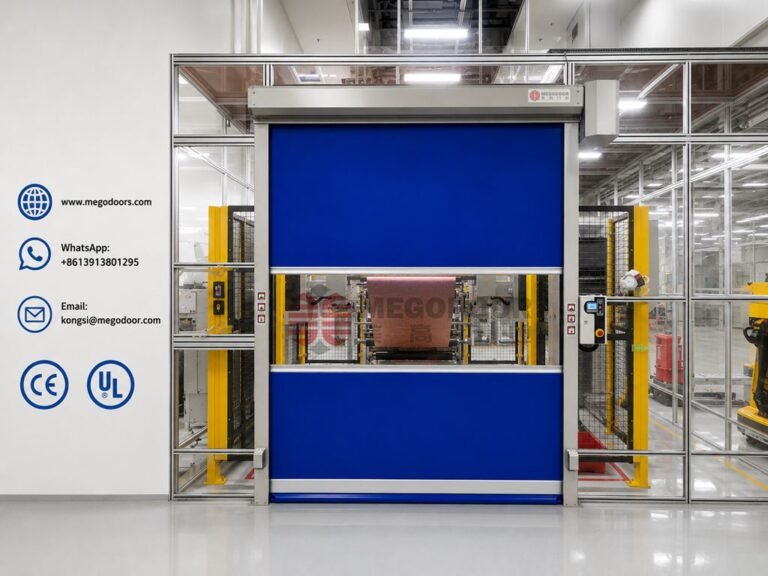
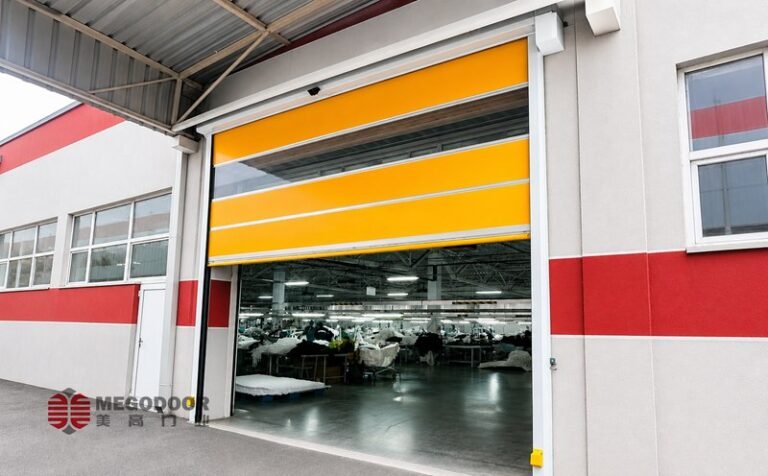
In food factory insect-control applications, the high-speed roll-up door is one of the most common and effective choices.
Compared with conventional rolling shutter doors, swing doors, or permanently open entrances, a high-speed roll-up door offers clear advantages: fast opening and closing speed, short open time, and automatic closing after passage. These features significantly reduce the amount of time the entrance is exposed.
The shorter the door remains open, the lower the chance for insects to fly inside.
This is especially important in food factories where forklifts and staff move in and out frequently. High-speed roll-up doors help create a more efficient and controlled entrance management system.
For food-grade factories, high-speed roll-up doors not only help prevent insects, but also help reduce dust entry, minimize air exchange, and improve overall environmental control inside the workshop.
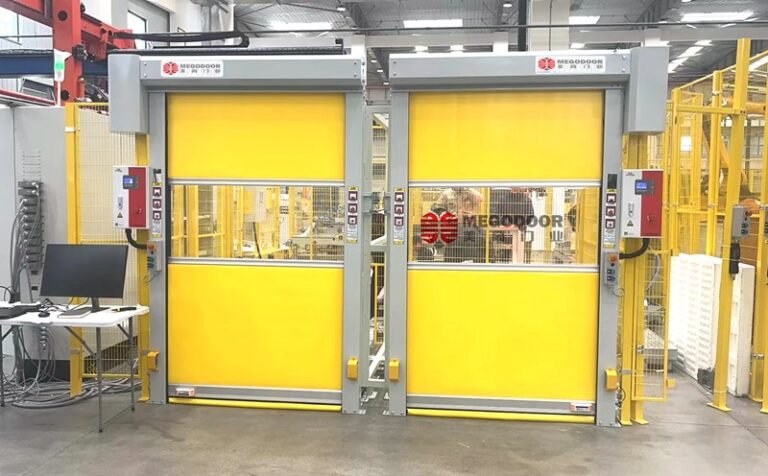
Solution 2: Use Double-Door Interlocking to Prevent Two Doors from Opening at the Same Time
If the workshop has even higher hygiene requirements, installing just one door may not be enough. In this case, a double-door interlocking system can be a better solution.
The core idea of door interlocking is simple: two doors cannot be opened at the same time. One door must close before the other can open.
This method is very practical in food factories, clean areas, buffer rooms, and pre-processing zones.
When the outer door is open, the inner door stays closed. After people or goods enter the buffer zone, the outer door closes and then the inner door opens. This arrangement greatly reduces the chance of outdoor air and insects entering the inner production area directly.
For insect prevention at food factory doors, double-door interlocking adds an extra isolation layer.
When combined with high-speed roll-up doors, the effect is often better, especially in the following areas:
- Food production workshop entrances
- Raw material buffer zones
- Packaging area passages
- Doorways to areas with higher cleanliness requirements
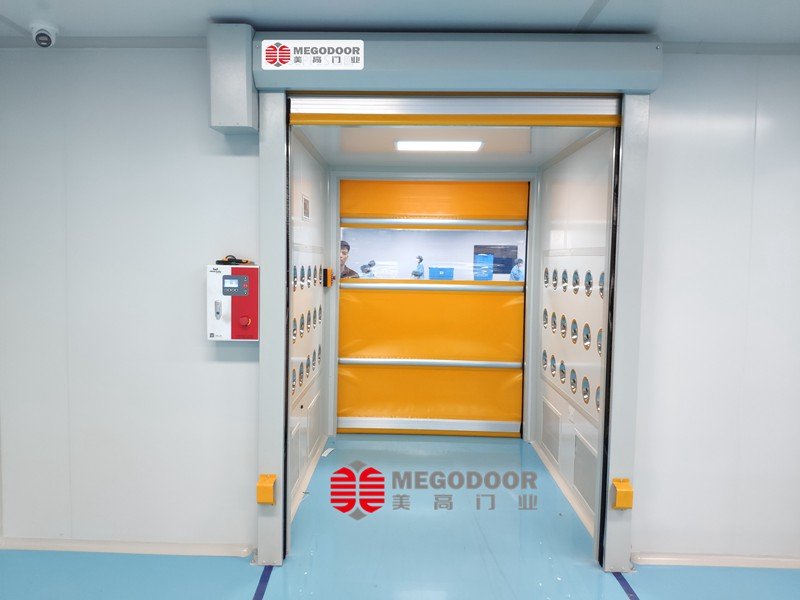
Solution 3: Install an Air Curtain to Create an Air Barrier
In addition to the door itself, an air curtain is also an important device for insect prevention at food-grade factory entrances.
Installed above the doorway, the air curtain blows a high-speed downward airflow, creating an “air barrier” that helps reduce the entry of insects, dust, and some outside air.
For entrances that need to open frequently, the effect of an air curtain can be especially useful.
When the door opens, the airflow barrier can interfere with the flying path of insects and reduce their chances of entering the workshop directly.
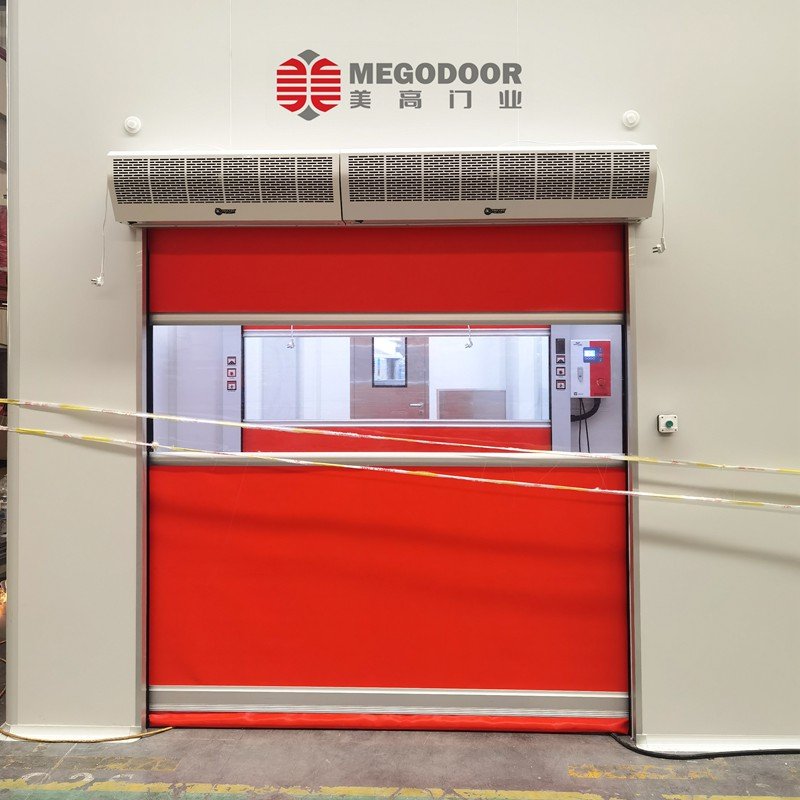
In food industry projects, air curtains are often used as supporting equipment together with high-speed roll-up doors. This combination not only improves entrance management, but also supports daily hygiene control.
Solution 4: Link the Air Curtain with the High-Speed Door for Better Practical Results
In actual use, simply installing an air curtain is often not enough. Linking the air curtain with the high-speed door is usually a more practical solution.
For example, when the high-speed door opens, the air curtain starts automatically. When the door closes, the air curtain can continue running for a short delay before shutting off. This setup offers several advantages:
First, the air curtain runs automatically whenever the door opens, without requiring separate manual operation.
Second, it reduces the chance of forgetting to turn the device on or off.
Third, it makes doorway protection more systematic and improves the overall user experience.
Fourth, it is especially suitable for food factories with frequent forklift movement and high personnel traffic.
For food-grade factories, linking the air curtain with the high-speed door is not only about automation. More importantly, it makes the insect-control system part of the actual traffic flow rather than just an accessory.
Solution 5: Use Yellow Strip Curtains to Reduce Attraction to Flying Insects
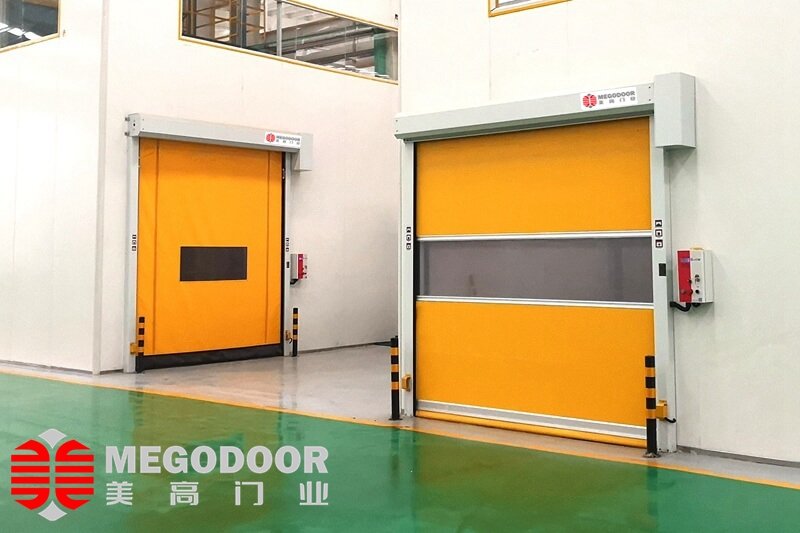
Many food factories also consider using yellow strip curtains at entrances or related areas.
In some practical applications, yellow transparent curtains are considered more suitable than ordinary colors in areas where reducing visual attraction to flying insects is a concern.
Yellow strip curtains are usually used as an auxiliary measure and are suitable for:
- Secondary passage separation
- Buffer zones between inside and outside areas
- Secondary entrances
- Local traffic openings
Of course, yellow strip curtains alone cannot replace a high-speed roll-up door, nor can they replace double-door interlocking or an air curtain.
A better approach is to treat them as an auxiliary part of the overall insect-control system for food-grade factory doors.
Solution 6: Install Mosquito Killer Lamps Near the Entrance to Reduce Insect Gathering
Besides the door and airflow devices, installing mosquito killer lamps near the entrance is also a common management practice.
If there is lighting near the doorway at night, or if the surrounding environment naturally attracts insects, the entrance area can easily become a gathering point. In this case, properly arranged mosquito killer lamps can help reduce the number of flying insects near the doorway.
It should be noted that the installation position and usage method of mosquito killer lamps should be planned according to the site conditions.
A common approach is to install mosquito killer lamps at suitable locations around the entrance and use them together with high-speed roll-up doors, air curtains, and double-door interlocking to form a combined solution of door isolation + airflow protection + insect trapping.
This kind of combined solution is usually more effective than relying on only one method, and it is more suitable for long-term use in food factories.
Why a Combined Solution Is Better for Insect Prevention at Food-Grade Factory Doors
Many customers initially ask questions such as:
“Is one high-speed roll-up door enough?”
“Will only an air curtain work?”
“Is hanging yellow strip curtains sufficient?”
In fact, for food-grade factory door insect prevention, a combined solution is usually recommended, because each device solves a different problem.
- High-speed roll-up door: reduces door opening time and exposure
- Double-door interlocking: prevents both doors from being open at the same time and improves isolation
- Air curtain: creates an air barrier
- Air curtain and high-speed door linkage: improves automation and practical performance
- Yellow strip curtains: serve as an auxiliary separation measure
- Mosquito killer lamps near the entrance: reduce insect gathering sources
When these measures are combined according to site conditions, the result is usually better than using any single device alone.
Which Food Factory Areas Are Suitable for This Kind of Solution
The following areas are usually suitable for this type of insect-control doorway solution:
- Entrances to food processing workshops
- Cooked food production areas
- Beverage factories
- Central kitchen passageways
- Between packaging workshops and outside logistics areas
- Raw material buffer areas
- Workshop entrances with higher cleanliness requirements
If the site has frequent forklift movement, heavy personnel traffic, obvious insect problems in summer, or doorways close to outdoor loading areas, it is even more important to consider a comprehensive insect-control entrance solution.
MEGODOOR’s Suggestion: Start from the Actual Workflow of the Workshop
Based on project experience, insect prevention at food-grade factory doors should not rely on just one product. It is better to configure the solution according to the actual workflow of the workshop. For example:
- Are personnel passages and logistics passages separated?
- Is there a buffer room?
- Does the door need automatic opening?
- Is double-door interlocking required?
- Should the air curtain be linked with the high-speed door?
- How should entrance lighting and mosquito killer lamps be arranged?
- Is it suitable to add yellow strip curtains as an auxiliary barrier?
The more thoroughly these details are considered, the more stable the long-term performance will be.
For food-grade factories, insect prevention is not a minor issue. It is closely related to daily hygiene management and workshop environmental control.
A practical way to improve insect prevention is to combine high-speed roll-up doors, double-door interlocking, air curtains, yellow strip curtains, air curtain and high-speed door linkage, and mosquito killer lamps installed near the entrance, then configure them according to the actual site conditions.
When planned properly, the factory door system can do more than just allow traffic. It can also play an important role in insect prevention, dust reduction, and environmental isolation.