Contact us on WhatsApp: +86 139 1380 1295 Email: kongsi@megodoor.com


In cold chain logistics, food processing plants, fresh produce warehouses, pharmaceutical cold storage facilities, and frozen goods distribution centers, cold room doors play a critical role in maintaining temperature control. However, they also directly affect energy consumption, operational efficiency, and overall warehouse performance.
In recent years, more and more companies have started replacing traditional cold room doors with insulated high-speed doors. Why is this trend growing so rapidly? As an industrial door solution provider, MEGODOOR would like to share the advantages of insulated high-speed doors and explain why they are becoming the preferred choice for modern cold storage facilities.
Challenges of Traditional Cold Room Doors
Traditional cold storage facilities commonly use sliding cold room doors or manual insulated doors. While these doors provide basic thermal insulation, they often create several operational challenges.
Slow Opening and Closing Speed
Conventional cold room doors typically require 10–20 seconds or even longer to open and close completely.
In facilities with frequent forklift traffic, operators often leave the doors open for convenience, resulting in significant cold air loss and increased refrigeration costs.
Condensation Issues
The large temperature difference between the cold storage area and the surrounding environment often causes condensation.
When doors remain open for extended periods, warm air enters the cold room and creates moisture buildup on walls, ceilings, and door frames. This can lead to slippery floors, safety hazards, and hygiene concerns.
Reduced Logistics Efficiency
Modern cold chain warehouses rely heavily on forklifts, AGVs, and automated transportation systems.
Traditional cold room doors often become bottlenecks due to their slow operating speed, reducing overall logistics efficiency.
Labor-Intensive Operation
Many older cold storage facilities still use manually operated doors.
Workers must frequently stop, open the door, move goods, and then close the door again, resulting in unnecessary labor and reduced productivity.
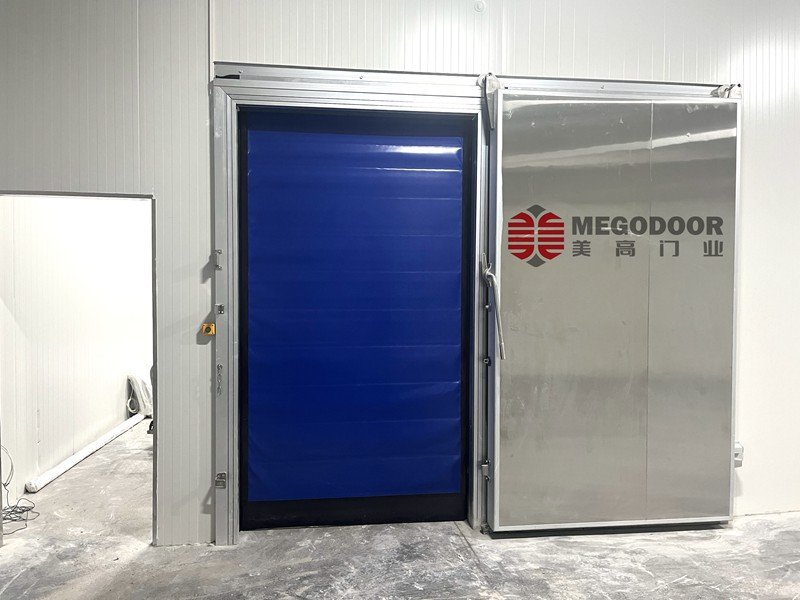
Why Can Insulated High-Speed Doors Replace Traditional Cold Room Doors?
To address the limitations of conventional cold room doors, MEGODOOR has developed insulated high-speed door solutions specifically designed for cold chain applications.
Fast Opening Reduces Cold Air Loss
MEGODOOR insulated high-speed doors can operate at speeds of 0.8–1.5 m/s.
The door opens within seconds, allowing forklifts to pass quickly before automatically closing.
Compared with traditional cold room doors, the shorter opening time significantly reduces cold air leakage and lowers refrigeration energy consumption.
Excellent Thermal Insulation Performance
The door panels are constructed with high-density polyurethane insulation materials that provide excellent thermal resistance.
This design minimizes heat transfer between the cold room and the outside environment, helping maintain stable temperatures while reducing cooling system workload.
Reduced Condensation Formation
Because the door opens and closes quickly, the exchange of warm and cold air is greatly reduced.
This helps minimize condensation, frost buildup, and moisture-related issues around the doorway area.
Designed for High-Frequency Operation
Traditional cold room doors are generally suitable for low-frequency usage.
In contrast, insulated high-speed doors are designed for hundreds or even thousands of operating cycles per day, making them ideal for busy cold storage facilities and logistics centers.
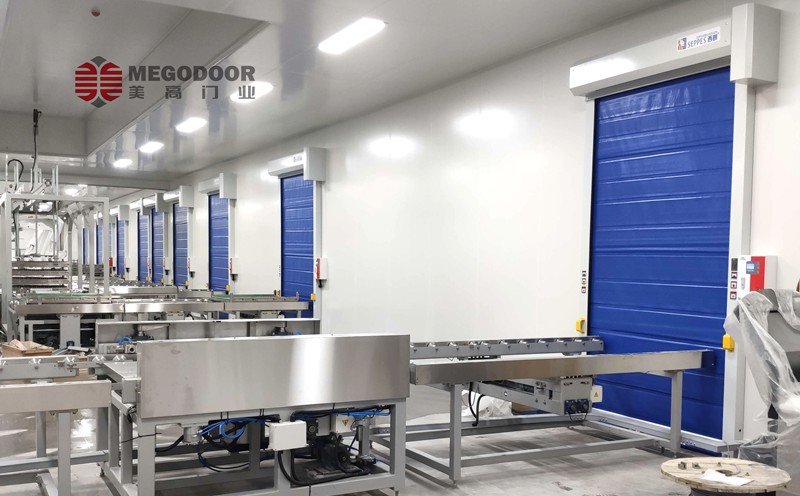
Ideal for Modern Automated Cold Storage Facilities
As warehouse automation continues to develop, more cold storage facilities are integrating AGVs, conveyors, and automated storage systems.
MEGODOOR insulated high-speed doors support a wide range of intelligent control options, including:
- Motion sensors
- Radar activation
- Magnetic loop detectors
- AGV communication systems
- PLC integration
- Card access control
- Facial recognition systems
- Remote monitoring and management
These features enable fully automated and efficient warehouse operations.
Advantages of MEGODOOR Insulated High-Speed Doors
As a professional industrial door manufacturer, MEGODOOR provides insulated high-speed door solutions for cold chain logistics, food processing, pharmaceutical manufacturing, intelligent warehousing, and other industries.
Key features include:
- Fast opening and closing speed
- Excellent thermal insulation performance
- High-density polyurethane insulated panels
- Superior sealing performance
- Suitable for low-temperature environments
- Reliable servo motor and control system
- AGV and automation system integration
- Multiple safety protection devices
- Custom sizes and colors available
- CE-compliant configurations for export projects
Recommended Applications
MEGODOOR insulated high-speed doors are widely used in:
- Cold chain logistics centers
- Frozen food warehouses
- Fresh produce distribution centers
- Meat processing plants
- Dairy production facilities
- Pharmaceutical cold storage
- Vaccine storage facilities
- Automated cold storage warehouses
For facilities with frequent forklift traffic, insulated high-speed doors can effectively replace traditional cold room doors while improving efficiency and reducing energy costs.
For modern cold storage facilities, a door is much more than a simple barrier. It directly impacts energy consumption, logistics efficiency, operational costs, and product quality.
Compared with traditional cold room doors, insulated high-speed doors offer faster operation, better insulation, lower energy consumption, and greater compatibility with automation systems.
With extensive experience in cold chain and industrial applications, MEGODOOR provides customized insulated high-speed door solutions tailored to your warehouse temperature requirements, opening sizes, traffic conditions, and automation needs.
If you are considering upgrading your cold storage facility, an insulated high-speed door may be one of the most effective investments for improving efficiency and reducing operating costs.