Contact us on WhatsApp: +86 13913801295 Email: kongsi@megodoor.com


As industrial buildings become larger and door openings continue to increase in size, conventional industrial doors are often no longer sufficient to meet the demands for wind resistance, safety, sealing, and thermal insulation. In coastal regions, open industrial parks, and large logistics centers, strong winds and seasonal storms can significantly impact building entrances. As a result, more manufacturers are paying attention to 12-level wind-resistant industrial electric doors.
Among various industrial door solutions, wind-resistant sectional doors are widely used in production facilities, equipment loading bays, logistics warehouses, aircraft maintenance hangars, and manufacturing plants. Their structural strength, reliable operation, and excellent sealing performance have made them a common choice for many multinational companies and publicly listed manufacturers.
What Is a 12-Level Wind-Resistant Sectional Door?
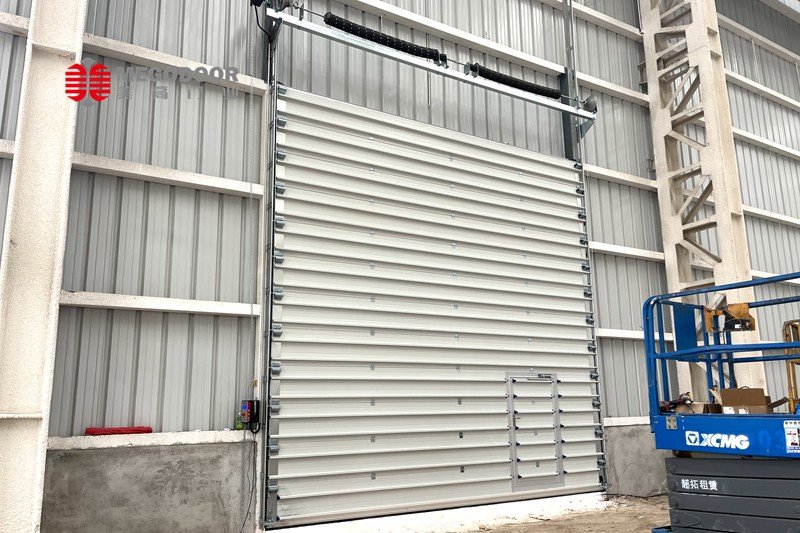
A 12-level wind-resistant sectional door refers to an industrial door system designed to withstand high wind loads through optimized structural engineering, reinforced door panels, heavy-duty guide tracks, and high-strength hardware. The actual wind resistance depends on factors such as door dimensions, local building wind load requirements, and the specific door configuration. Different sizes and applications require different engineering designs.
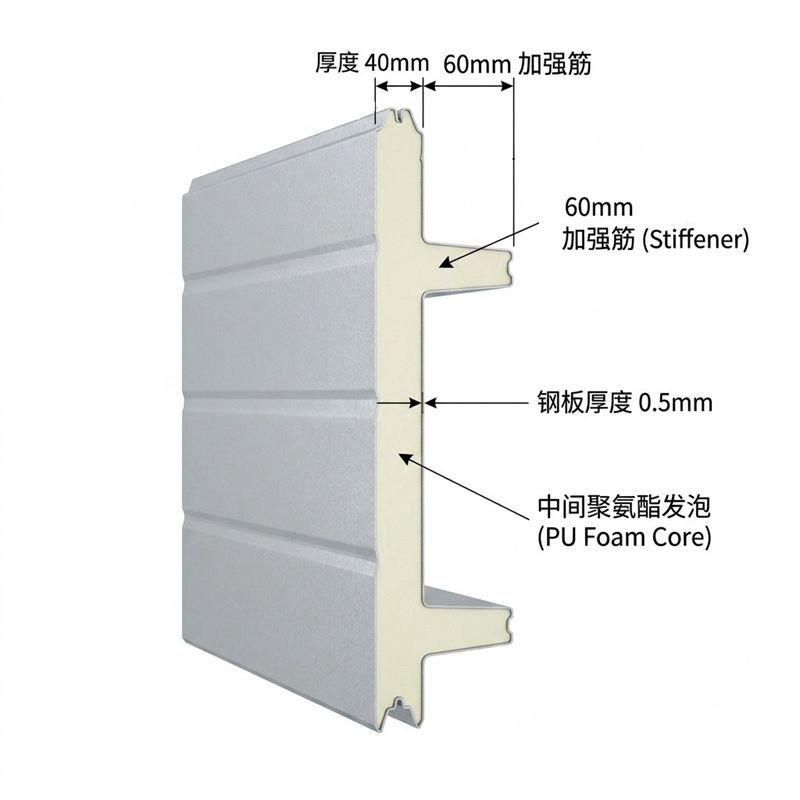
MEGODOOR wind-resistant sectional doors can be equipped with reinforced door panels featuring internal strengthening ribs, providing greater structural rigidity and improved resistance to wind pressure. Compared with standard door panels, reinforced panels help reduce deformation under strong wind conditions while distributing loads more evenly across the entire door system.
In addition to enhanced wind resistance, these doors also provide several important industrial benefits:
- Reinforced door panels with strengthening ribs for improved structural rigidity
- High-density polyurethane insulation for excellent thermal performance
- Multiple sealing systems to reduce rainwater, dust, and air infiltration
- Integrated safety protection devices for reliable daily operation
- Compatibility with access control systems, PLCs, AGVs, and other factory automation equipment
For modern industrial facilities, an entrance door is more than just an access point. It also plays an important role in energy efficiency, environmental control, and operational safety.
Why Are Sectional Doors More Suitable Than Roller Shutter Doors for Large Openings?
Roller shutter doors are often selected because of their relatively low initial investment. However, when door openings reach widths of 5, 6 meters or more, the structural differences between roller shutters and sectional doors become increasingly significant.
Traditional roller shutter doors rely on interlocking slats that roll around a barrel. For very large openings exposed to strong wind pressure, the curtain may experience higher deformation and structural stress.
Wind-resistant sectional doors use insulated panel sections guided along heavy-duty tracks. The door panels are connected by hinges and supported by reinforcement ribs, rollers, tracks, and a balanced lifting mechanism. This structural design generally provides greater stability for large industrial door openings.
In addition, sectional doors feature perimeter sealing systems that help reduce rainwater penetration, dust infiltration, and heat loss, making them particularly suitable for manufacturing plants, logistics centers, cold storage facilities, and other industrial applications.
The Entire Door System Matters More Than Individual Components
When purchasing an industrial door, many buyers focus primarily on panel thickness, motor power, or price. However, the reliability of the complete door system is equally important.
During various projects, MEGODOOR has found that some suppliers reduce costs by using roller shutter motors and shaft assemblies instead of dedicated sectional door operators and torsion spring balancing systems.
Although this approach may reduce the initial purchase cost, sectional doors are designed to operate as balanced lifting systems. Without a properly engineered torsion spring balancing mechanism, the motor must bear a significantly higher load during every operating cycle, which may reduce system reliability, shorten service life, and increase potential safety risks.
A professionally designed wind-resistant sectional door should include:
- A dedicated sectional door operator
- A properly engineered torsion spring balancing system
- Heavy-duty guide tracks
- High-quality hardware components
- Professionally matched structural design
When selecting an industrial door supplier, companies are advised to evaluate not only the purchase price but also:
- Whether the supplier provides a complete sectional door system
- Whether dedicated sectional door operators and torsion spring systems are used
- Whether wind resistance is engineered according to door dimensions and local building requirements
- Installation quality and after-sales service capabilities
- Experience with large industrial projects
Project Experience
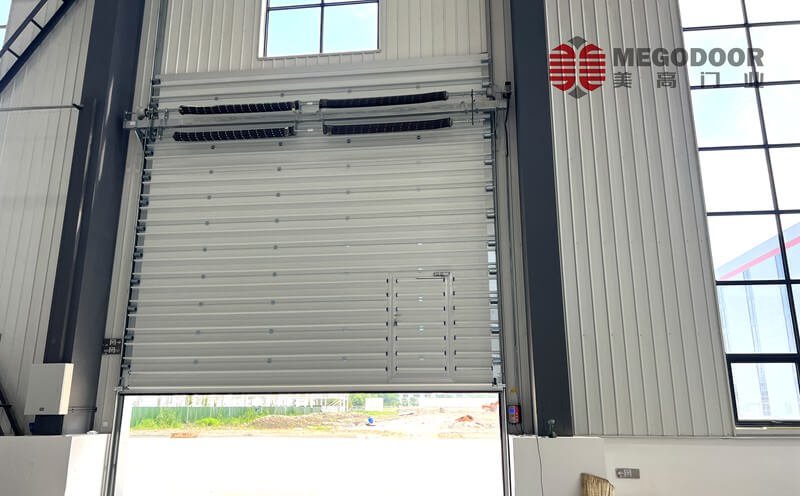
One electrical manufacturing company in Nanjing installed a door with an opening size of approximately 6000 × 4500 mm for an equipment loading bay.
To reduce construction costs, the original contractor selected a conventional roller shutter door. During a summer storm, the door was damaged by strong winds, and rainwater also entered the building through the entrance.
The customer later upgraded the entrance with a MEGODOOR wind-resistant sectional door. The new system featured reinforced door panels with strengthening ribs and a complete sectional door balancing system specifically designed for the site conditions.
After more than two years of operation, including multiple typhoon and strong wind events, the door has continued to operate reliably while significantly improving protection against rainwater intrusion.
Based on this operating experience, the customer subsequently upgraded several additional exterior entrances to similar wind-resistant sectional door systems.
This project is shared as a practical engineering example. Actual performance may vary depending on door size, local wind load requirements, installation conditions, and product configuration.
For modern industrial facilities, an electric door is not simply an entrance—it directly affects operational efficiency, building safety, energy performance, and long-term maintenance costs.
For large door openings or projects located in coastal or high-wind regions, a professionally engineered wind-resistant sectional door is often a more suitable solution than a conventional roller shutter door.
MEGODOOR specializes in the design and manufacture of industrial door systems. We provide customized sectional door solutions based on local wind load requirements, building conditions, and operational needs, helping customers achieve reliable wind resistance, excellent sealing performance, thermal insulation, and long-term operational stability.