Contact us on WhatsApp: +86 13913801295 Email: kongsi@megodoor.com

High-speed doors for cleanrooms are widely used in electronics manufacturing, food processing, pharmaceutical production, precision engineering, and lithium battery facilities. Unlike conventional industrial workshops, cleanrooms have higher requirements for cleanliness, airtightness, and equipment reliability. Therefore, selecting a suitable high-speed door involves more than simply comparing prices and opening speeds.Based on years of industrial door manufacturing and project experience, Nanjing MEGODOOR Co., Ltd. believes that the long-term reliability of a cleanroom high-speed door depends not only on the door curtain and motor, but also on the frame material, steel thickness, manufacturing process, and electrical control system.Some manufacturers reduce production costs by using thinner door frames, lower-cost motors, or electrical components. Although these doors may operate normally after installation, problems such as frame vibration, photoelectric sensor misalignment, repeated automatic opening and closing, and control system failures may develop over time.

1. Painted Steel or Stainless Steel: Which Frame Is Better for Cleanroom High-Speed Doors?
Common frame materials for cleanroom high-speed doors include powder-coated galvanized steel, 304 stainless steel, and 201 stainless steel. Each material has different characteristics and applications.
Powder-Coated Galvanized Steel Frames
For electronics factories, automated production workshops, and general cleanroom environments, powder-coated galvanized steel frames offer a practical and cost-effective solution.
MEGODOOR recommends using 2.0 mm thick galvanized steel, manufactured through laser cutting, CNC bending, and surface coating processes to provide suitable structural strength and stability.

Some low-cost high-speed doors use 1.5 mm or even thinner steel sheets, often formed through roll-forming processes. While this reduces manufacturing costs, insufficient structural reinforcement may result in poor frame rigidity, especially for larger doors or high-frequency operation.
304 Stainless Steel Frames
For food processing plants, pharmaceutical facilities, and cleanrooms requiring frequent cleaning, MEGODOOR generally recommends 304 stainless steel frames.
304 stainless steel offers good corrosion resistance and is relatively easy to clean and maintain, making it suitable for environments with higher hygiene requirements.
However, stainless steel does not automatically mean greater structural strength. Some manufacturers use 1.2 mm thick 304 stainless steel for door frames. Without proper reinforcement, these frames may experience deformation or vibration after prolonged operation.
MEGODOOR recommends selecting an appropriate frame thickness and reinforcement design according to the door dimensions and application. For projects requiring higher frame rigidity, 2.0 mm thick 304 stainless steel can be considered.
Why Doesn’t MEGODOOR Recommend 201 Stainless Steel?
Although 201 stainless steel is generally less expensive, its corrosion resistance is typically lower than that of 304 stainless steel.
Cleanrooms often require regular cleaning, and some areas are exposed to moisture, disinfectants, and cleaning chemicals. Under these conditions, 201 stainless steel may have a higher risk of surface corrosion and increased maintenance requirements.
Therefore, for cleanrooms with strict hygiene requirements, frequent cleaning procedures, or demanding corrosion-resistance needs, MEGODOOR generally does not recommend 201 stainless steel frames.

2. What Problems Can Occur When Manufacturers Reduce Door Frame Thickness?
Many customers wonder why frame thickness matters when a high-speed door simply opens and closes vertically.
In fact, high-speed doors experience vibration during motor operation, curtain movement, and bottom-edge travel. If the frame lacks sufficient rigidity or is not securely installed, repeated high-frequency operation may gradually cause vibration, deformation, or component misalignment.
Photoelectric Sensor Misalignment
High-speed doors are commonly equipped with infrared photoelectric safety sensors on both sides.
If the frame vibrates excessively or becomes deformed, the transmitter and receiver may become misaligned, interrupting the safety signal. This can prevent the door from closing normally or cause unexpected operating interruptions.
Repeated Automatic Opening and Closing
Some customers report that their high-speed doors repeatedly open and close even when no people or vehicles are passing through.
This problem may be caused by incorrect radar positioning, door vibration, the curtain entering the radar detection zone, or interference from nearby equipment.
Insufficient frame stability can increase the risk of false triggering, although the radar settings and surrounding environment should also be checked.
Increased Maintenance Requirements
Poor frame rigidity may also affect the alignment of guide rails, door curtains, and other mechanical components. Over time, this can increase operating noise, accelerate curtain wear, or cause unstable movement.
For cleanroom facilities, door failures create more than maintenance costs. Frequent repairs may introduce dust, require additional personnel access, and disrupt environmental control procedures.
A cleanroom high-speed door should not only operate properly when first installed. It should also maintain reliable performance during long-term, high-frequency use.
3. Why Are Motor and Electrical Control Quality Important?
In addition to frame construction, the motor and electrical control system play an important role in the reliability of cleanroom high-speed doors.
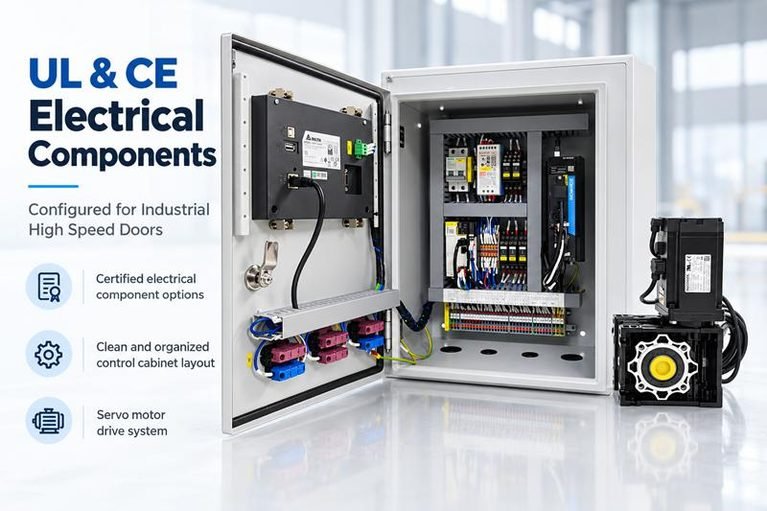
Modern high-speed doors commonly use servo motor systems, with motor power and control configurations selected according to door size, opening speed, and operating frequency.
MEGODOOR recommends choosing motor and control system brands with proven industrial applications, stable performance, and dependable technical support rather than focusing only on motor power or purchase price.
Some lower-cost drive systems may develop problems after prolonged operation, including gearbox seal failure, lubricant leakage, motor abnormalities, or electrical control faults.
Gearbox oil leakage deserves particular attention in cleanroom applications. Oil leakage can increase maintenance requirements and create contamination risks in controlled production environments.
Therefore, gearbox sealing, lubrication methods, and maintenance accessibility should be considered during product selection.
The electrical control system also affects the reliability of radar sensors, safety photocells, wireless safety edges, and equipment communication signals.
Cleanroom high-speed doors may operate many times throughout the day. Frequent electrical faults can interrupt production and require maintenance personnel to enter controlled areas.
MEGODOOR believes that the motor, electrical control system, and mechanical structure should be evaluated as a complete system. Reducing the initial purchase price should not come at the expense of long-term operational reliability.
4. How to Choose a Reliable Cleanroom High-Speed Door Manufacturer
When selecting a high-speed door for a cleanroom, customers should consider not only the frame material and motor system but also the sealing requirements and operating environment.
Conventional PVC high-speed roll-up doors can meet the needs of many production workshops. However, for cleanrooms requiring better airtightness and pressure differential control, zipper high-speed doors may be a more suitable option.
Zipper high-speed doors use an interlocking zipper-guided curtain design to improve sealing performance along the side guides, helping reduce unwanted airflow between controlled areas.
Nanjing MEGODOOR Co., Ltd. manufactures PVC high-speed doors, zipper high-speed doors, and machine protection high-speed doors for different industrial applications.
Depending on project requirements, MEGODOOR can provide:
- 2.0 mm powder-coated galvanized steel frames
- 304 stainless steel frames with customized thickness
- Industrial servo motor and control systems
- Infrared photoelectric sensors and wireless safety edges
- Radar sensors and automatic opening systems
- PLC communication and equipment interlocking functions
- Customized sealing solutions for cleanroom environments
Before purchasing, customers should verify the manufacturer’s frame thickness, material specifications, manufacturing processes, motor configuration, and actual project experience.
For facilities with higher cleanliness requirements, sealing performance, pressure differential conditions, and cleaning procedures should also be evaluated.
The cheapest cleanroom high-speed door is not necessarily the most cost-effective choice. Frequent sensor failures, frame vibration, oil leakage, and unexpected maintenance may result in operating expenses far exceeding the initial savings.


MEGODOOR focuses on practical engineering solutions, appropriate material selection, structural stability, and reliable electrical systems rather than exaggerated performance claims.
With experience in industrial door manufacturing and international projects, MEGODOOR provides customized cleanroom high-speed door solutions for electronics, pharmaceutical, food processing, lithium battery, and other industrial applications.