Contact us on WhatsApp: +86 13913801295 Email: kongsi@megodoor.com


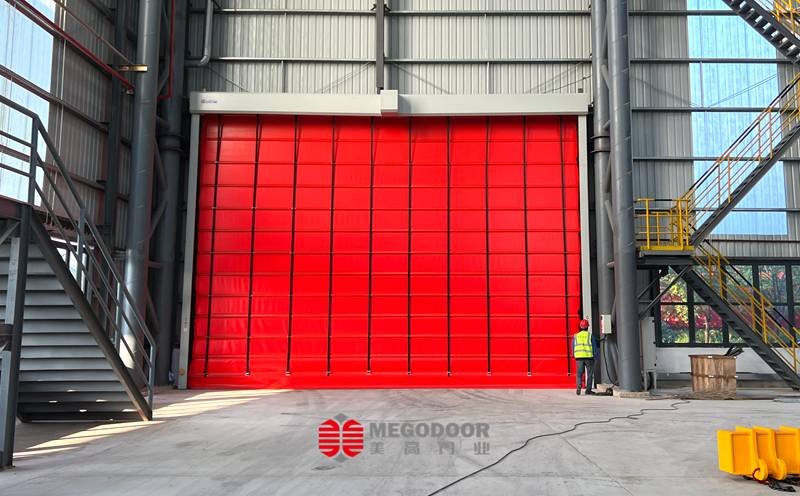
Which industrial door should you choose when your factory has a large opening, frequent forklift and truck traffic, and exposure to wind? A high-speed stacking door is an option worth considering.Nanjing MEGODOOR Co., Ltd. explains the key selection factors, covering door construction, suitable applications, opening dimensions, and operating requirements.
How Does a Stacking Door Work?
A stacking door uses lifting straps to raise its flexible curtain. As the door opens, the curtain folds upward in sections and stacks above the opening. This differs from a conventional high-speed roll-up door, which winds its curtain around a shaft.
The curtain typically consists of polyester fabric coated with PVC on both sides, supported by horizontal wind bars, side guides, and a bottom seal. The size, quantity, and spacing of the wind bars must be determined according to the opening dimensions and site wind pressure.
MEGODOOR can customize curtain thickness, frame materials, and transparent vision panels to suit the application.
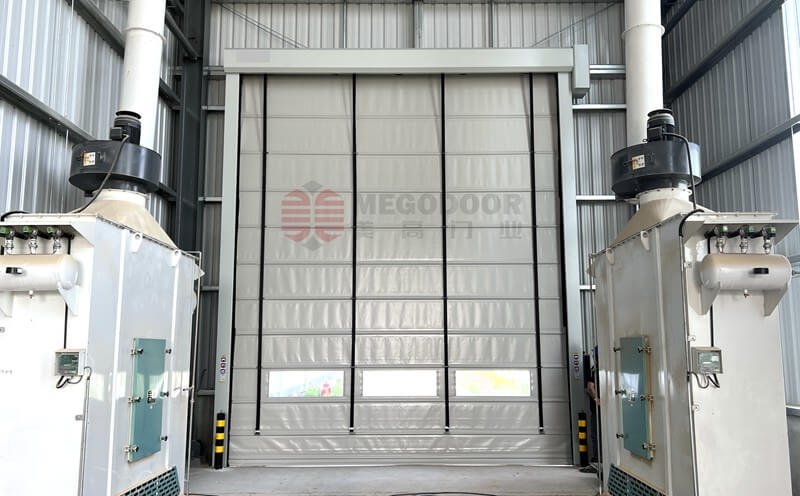
Where Are Stacking Doors Suitable?
Stacking doors are primarily used for large industrial openings with frequent traffic where wind protection, dust reduction, and area separation are required.
Large production workshops are a common application. Machinery manufacturers, automotive component suppliers, and equipment manufacturers often need wide access for forklifts, transport vehicles, or oversized workpieces. Stacking doors can be sized to accommodate these movements.
Warehouse and logistics passageways are another suitable application. Automatic opening and delayed closing reduce manual operation and limit the time the opening remains exposed, supporting efficient material handling.
For exterior factory entrances exposed to wind and dust, curtain reinforcement and guide structures can be configured according to site conditions. Selection should also account for the mounting structure, opening dimensions, and fixing methods.
For cleanrooms with demanding airtightness or differential pressure requirements, the sealing design requires a separate assessment. A standard stacking door should not automatically be treated as a dedicated cleanroom door.
How Large Can a Stacking Door Be?
Depending on project conditions, MEGODOOR can offer customized stacking doors up to approximately 12 metres wide and 10 metres high. Available dimensions and configurations require project-specific confirmation; different combinations of width and height may require different structural designs.
The specified door width and height refer to the clear opening width and clear opening height. They exclude the space occupied by the side guides, overhead curtain stack, and motor.
In addition to measuring the opening, check the following:
- Sufficient headroom for the folded curtain.
- Adequate side clearance for the guides and drive system.
- A wall or steel structure suitable for securing the door.
- Potential interference from fire protection pipes, cable trays, or other equipment.
As the opening becomes wider, the wind bars, guides, and connections generally face greater structural demands. Reinforcement should be determined by the actual operating conditions rather than a single universal width threshold.
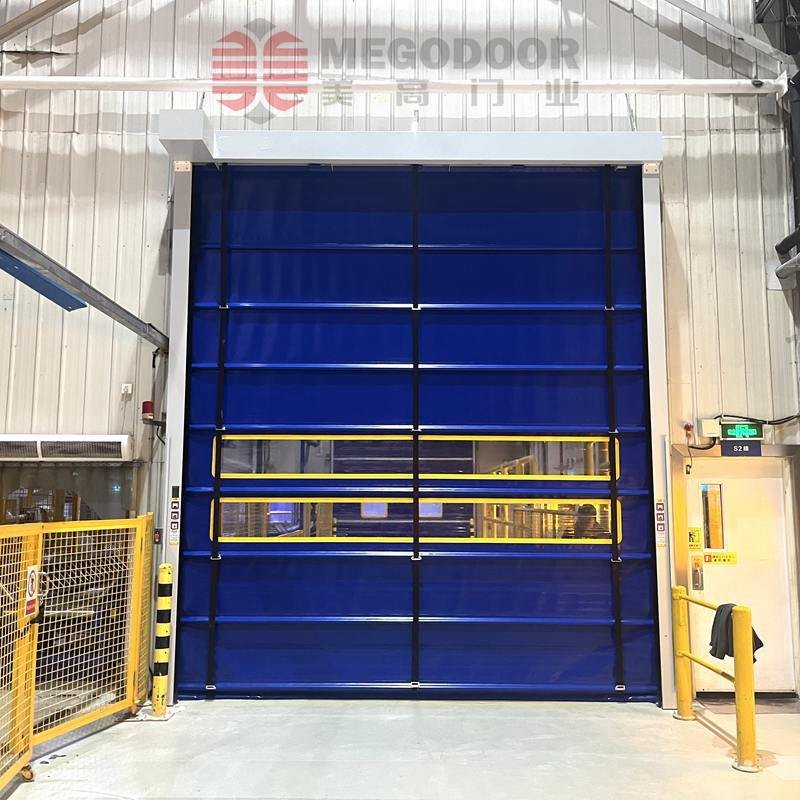
Consider Wind Resistance and Operating Speed Together
MEGODOOR can provide stacking door configurations designed for project requirements corresponding to Beaufort wind forces 10–12. Actual performance depends on the specific door dimensions, construction, and applicable test or design documentation. The performance of one door size cannot be assumed to apply to every large opening.
Operating speed must also be selected according to curtain weight, opening height, drive system, and traffic conditions. Large doors require a balance between efficient movement and stable operation, and opening and closing speeds can be set separately.
A door’s wind resistance when closed does not mean it can operate normally at high speed under the same wind conditions.
Control options include push buttons, remote controls, radar sensors, and induction loops. Communication interfaces can also be configured for integration with AGVs or production line systems.
What If Thermal Insulation Is Required?
Standard PVC stacking doors are mainly intended for wind protection, dust reduction, and rapid separation. Prompt closing helps reduce air exchange, but a single-layer curtain provides limited thermal insulation. Increasing curtain thickness alone does not make it equivalent to a purpose-built insulated door.
For workshops with defined temperature-control requirements, MEGODOOR evaluates insulated curtain options or other insulated industrial door designs based on the indoor–outdoor temperature difference, traffic frequency, and opening dimensions.
When specifying a stacking door, provide the clear opening dimensions, installation location, wind conditions, daily operating cycles, and control requirements. These details help determine the appropriate curtain, wind reinforcement, and drive configuration. MEGODOOR develops customized solutions to meet the access requirements of large industrial passageways while supporting practical operation and maintenance.