Contact us on WhatsApp: +86 13913801295 Email: kongsi@megodoor.com


As Chinese machinery and automation equipment manufacturers continue to expand into international markets, more production lines, robotic workstations, battery manufacturing equipment, and industrial automation systems are being exported to the United States, Europe, and other regions.For certain projects, the complete equipment must undergo CE conformity assessment, UL certification, or third-party safety inspection before being shipped overseas.
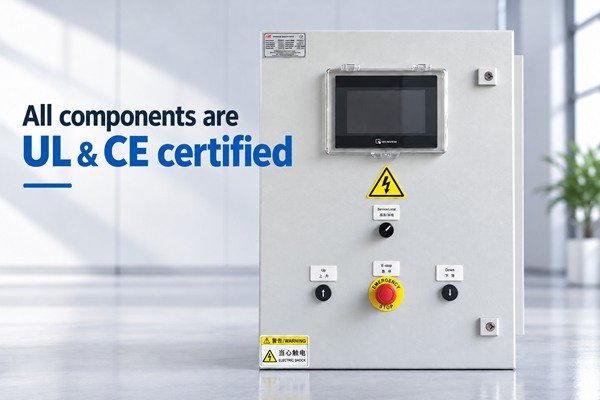
When selecting a roller shutter door for automated equipment, manufacturers must consider not only the door’s operating performance, safety protection, and automation compatibility but also the certification status of its electrical components.Based on its experience with international industrial projects, Nanjing MEGODOOR Co., Ltd. recommends that equipment manufacturers verify the certification status of individual electrical components rather than relying solely on the UL certification of the motor or the door assembly.
1. Why Do Roller Shutter Doors Require Special Attention During Complete Equipment UL Certification?
For ordinary industrial buildings, roller shutter doors are generally installed as independent products. Their main requirements include opening speed, operational safety, durability, and sealing performance.
However, roller shutter doors integrated into automated production equipment are different.
For example, when an automated production line is manufactured and assembled in China for export to the United States, the entire equipment system may need to undergo electrical safety evaluation before shipment.
In such cases, the roller shutter door becomes part of the overall equipment system. Its motor, control panel, electrical components, safety devices, and communication interfaces may all be included in the certification assessment.
If the selected electrical components do not meet the applicable requirements, the certification body may request modifications, including replacing electrical components, modifying wiring, or redesigning parts of the control system.
These changes can increase costs and delay equipment delivery.
MEGODOOR recommends confirming the certification requirements during the initial equipment design stage rather than waiting until final inspection to make modifications.

2. UL Certification of the Motor Does Not Mean the Entire Door System Is UL Certified
One common misunderstanding in international industrial projects is assuming that a roller shutter door meets UL requirements simply because it uses a UL-certified motor.
In reality, the certification status of the motor does not automatically cover the complete electrical control system.
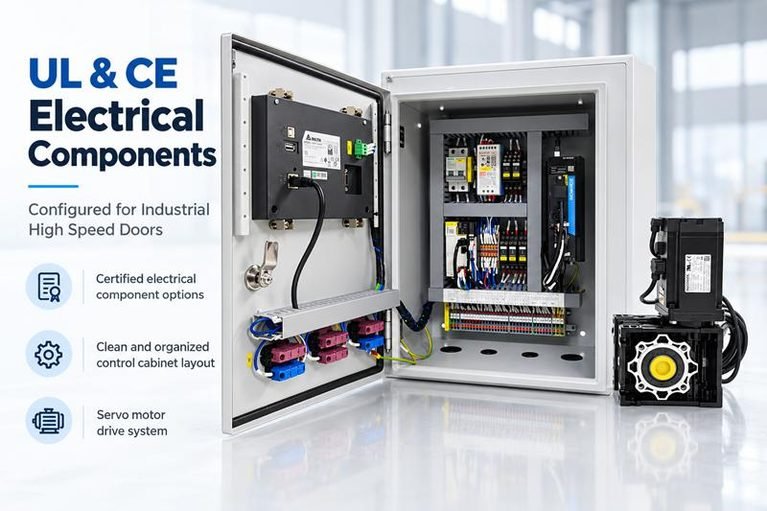
For equipment requiring strict UL compliance, the following electrical components may need to be individually verified:
- Drive Motor: Confirm the exact motor model, voltage, and applicable UL certification.
- Servo Drive or Frequency Inverter: Verify that the specific model meets the project’s certification requirements.
- Controller and PLC: Check the certification status, electrical ratings, and compatibility.
- Contactors, Relays, and Circuit Breakers: Select appropriately certified components according to the electrical design.
- Power Supplies, Terminal Blocks, and Connectors: Verify certification details and permitted operating conditions.
- Safety Photoelectric Sensors, Safety Edges, and Emergency Stop Devices: Select suitable safety components according to the equipment risk assessment.
- Electrical Cables and Wiring Accessories: Confirm the appropriate cable ratings, wiring methods, and installation requirements.
It is important to understand that UL Listed products and UL Recognized Components are not necessarily interchangeable. Some components also have specific conditions of acceptability.
Even when all relevant electrical components have applicable UL certifications, the complete door system or final equipment does not automatically become UL certified.
The final assembly must still be evaluated according to the applicable standards and certification procedures.
3. Different Models from the Same Electrical Brand May Have Different Certifications
Another important consideration is that not every product from the same electrical manufacturer carries the same certification.
For example, certain servo drive models may have UL certification, while other models within the same product family may not.
Certification coverage may also differ depending on voltage, power rating, hardware version, or product configuration.
In addition, manufacturers may update product models and certification documentation over time.
Therefore, choosing a well-known electrical brand alone does not guarantee compliance with the requirements of a specific overseas project.
For equipment requiring UL certification, MEGODOOR recommends verifying the following information before production:
- Exact electrical component model numbers.
- Applicable UL certification or recognition information.
- Rated voltage, current, and operating conditions.
- Relevant certification documentation.
- Compatibility with the complete equipment’s safety requirements.
For projects with strict certification requirements, the electrical component list should be reviewed by the equipment manufacturer or certification body before production begins.
This can significantly reduce the risk of costly modifications during final inspection.
4. Differences Between CE and UL Requirements for Roller Shutter Doors
Equipment exported to Europe and the United States may be subject to different regulatory frameworks and technical standards.
Equipment Exported to Europe – CE Requirements
Equipment placed on the European market generally needs to meet the applicable EU legislation and conformity assessment requirements.
Depending on the equipment, relevant requirements may include machinery safety, electrical safety, and electromagnetic compatibility.
The roller shutter door and its electrical system must be selected and integrated according to the applicable requirements, with appropriate technical documentation available.
It is worth noting that CE marking does not necessarily require every individual electrical component to hold a separate third-party certification.
Equipment Exported to the United States – UL Requirements
For projects requiring UL or other NRTL certification, electrical components, control systems, wiring methods, and safety functions may need to be evaluated against the applicable US standards.
The exact certification requirements depend on the equipment application, installation conditions, and the standards identified by the certification body.
For roller shutter doors integrated into automated production equipment, additional technical requirements may include:
- Communication with the main equipment PLC.
- Door fully-open and fully-closed position signals.
- Emergency stop and safety interlock functions.
- Optional STO (Safe Torque Off) functionality where required by the risk assessment.
- Proper electrical wiring, cable protection, and control cabinet design.
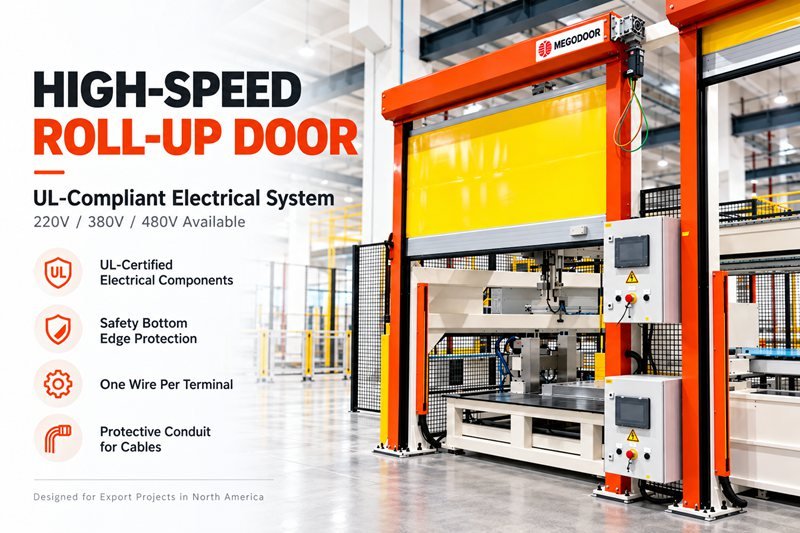
- Customized voltage options, such as 220V, 380V, or 480V.
- Compatibility with the overall equipment safety control system.
Therefore, a standard industrial roller shutter door control system may not be suitable for every equipment certification project.
5. Why Choose a Roller Shutter Door Manufacturer with Similar Project Experience?
For automated equipment requiring complete UL certification, the experience of the roller shutter door manufacturer is an important factor.
This is especially true for equipment manufactured, assembled, tested, and certified in China before being exported to overseas factories.
MEGODOOR recommends evaluating suppliers in three key areas.
Experience with Complete Equipment Certification
An experienced manufacturer should understand the importance of electrical component selection, certification documentation, safety circuits, and communication with the equipment manufacturer’s engineering team.
Early technical coordination can help prevent certification-related problems.
Customized Electrical Control Systems
Different automated machines may require different PLC interfaces, communication protocols, interlocking functions, and safety configurations.
A qualified roller shutter door supplier should be able to provide customized electrical control solutions rather than relying only on standard configurations.
Installation, Testing, and Modification Support in China
For equipment undergoing certification inspection in China, it is advisable to complete the roller shutter door installation and system integration before shipment.
If the certification body identifies nonconformities, the door manufacturer should be able to assist promptly with:
- Replacing electrical components.
- Modifying control cabinet wiring.
- Adjusting PLC signals and interlocking logic.
- Updating safety-related functions.
- Conducting additional system testing.
Completing these modifications before international shipment can help reduce delays and avoid more expensive modifications overseas.
6. MEGODOOR’s Experience with International Industrial Projects
Nanjing MEGODOOR Co., Ltd. specializes in industrial roller shutter doors, machine protection doors, high-speed industrial doors, and customized automation-compatible door systems.
MEGODOOR has experience supplying industrial door solutions for international manufacturing projects, including projects associated with Fortune Global 500 companies.
Our project experience includes:
- MLILY Factory Project – USA
- Empire Star Factory Project – USA
- SEG Factory Project – USA
- Midea Factory Project – USA
- Battery Manufacturing Factory Project – Turkey
These projects involve different industrial applications and technical requirements, including electrical system configuration, operational safety, equipment integration, and overseas installation conditions.
For projects requiring complete equipment UL certification or CE conformity assessment, MEGODOOR can provide customized electrical configurations according to the customer’s technical specifications.
We can also support installation, commissioning, equipment integration, and technical modifications during certification inspections conducted in China.
Specific certification requirements and final approval remain subject to the applicable standards and the assessment of the relevant certification body.
7. What Information Should Equipment Manufacturers Confirm Before Ordering?
To select a suitable roller shutter door for overseas industrial equipment, MEGODOOR recommends confirming the following details during the quotation stage:
- Export Destination: United States, Canada, European Union, or other markets.
- Certification Requirements: Applicable UL, CE, or other equipment safety standards.
- Door Dimensions: Clear opening width, height, quantity, and installation space.
- Electrical Supply: Voltage, frequency, and electrical connection requirements.
- Automation Integration: PLC communication, opening and closing signals, and equipment interlocking.
- Safety Requirements: Emergency stop, safety sensors, STO, and other safety functions where applicable.
- Certification Inspection: Whether installation, commissioning, and third-party inspection will be completed in China before export.
Providing these details early allows the door manufacturer to develop a more appropriate electrical and mechanical configuration.
Conclusion
When selecting a roller shutter door for automated equipment requiring UL certification, equipment manufacturers should look beyond product pricing and general certification claims.
The key is to verify the exact electrical component models, certification coverage, control system design, and compatibility with the overall equipment safety requirements.
With experience supporting industrial projects in the United States, Europe, and other international markets, MEGODOOR provides customized roller shutter door solutions for machinery manufacturers and automation system integrators.
Our engineering team can assist with electrical component selection, customized control systems, installation, commissioning, and technical modifications during equipment certification assessments.